
Baptism by Beauty
On unlearning bad aesthetics

“The only true voyage of discovery, the only fountain of Eternal Youth, would be not to visit strange lands but to possess other eyes, to behold the universe through the eyes of another, of a hundred others, to behold the hundred universes that each of them beholds, that each of them is;” — Marcel Proust
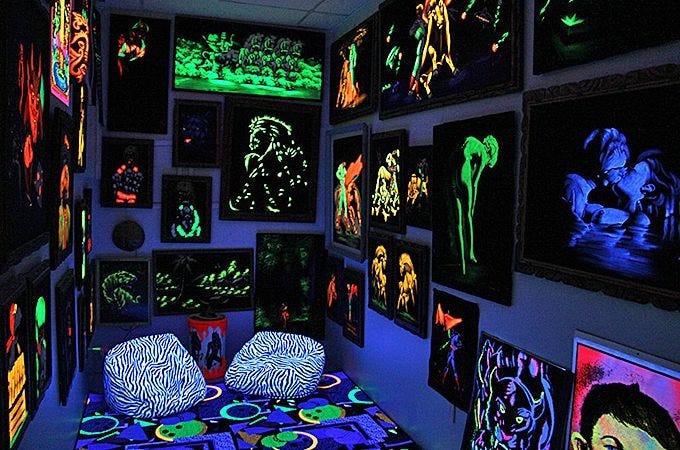
I love the indiscriminate taste of children. They haven’t yet learned snobbery when it comes to aesthetics, and they’re attracted to beauty without filters. The bright melange of toy aisles are filled with wild color, sparkles, shimmer, silver, smooth plastic, rainbows, fuzzy textures. I loved many things adults call ugly - those bottles of rainbow sand you could find at carnivals and craft fairs, velvet neon paintings, those metallic holographic pictures of wolves and eagles you could find at truck stops and gift shops. I have clear memories of being in a bathtub, amazed at the way the water subverted the shape of the toys. The dimensions of space seemed to take on a new depth. I had yet to learn how to contextualize and prioritize the things I saw in an adult way, so everything had a bright significance. Every moment could extend on forever, and time became a well pointing downwards beneath me. I never wanted to get out of the bathtub. I didn’t fully understand why I had to let any bright and beautiful moment end.
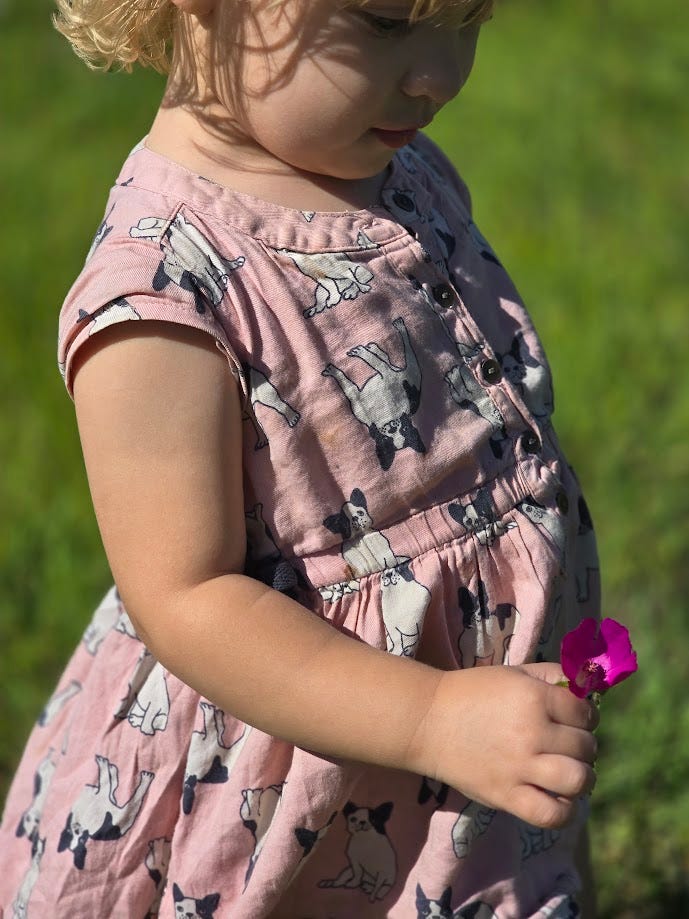
Taste refinement begins at a young age, however. I’ve started to see my three-year-old daughter develop preferences. She’s no longer grabbing at every pretty thing she sees. She’s started to discriminate - she likes the color pink and rainbows and ruffled dresses. I’ve draped her room in pink blankets, and a pink velvet toy chest, and a miniature pink tree for Christmas, and lately she’s refused to wear any clothes that aren’t pink. She’ll wear a pink princess dress and I’ll paint her nails pink and she’ll go to bed on a fuzzy pink pillow underneath the pink comforters. Every time we go to the store she’ll gravitate toward pink items, pick them up, and examine them. Once she asked for my notebook and when I told her she couldn’t have it, she put her hands on her hips in protest and declared, “But it’s pink!” Pink is more than a pretty color. It’s a kind of sacred talisman. “Pink is my favorite color,” is not so much a declaration of taste, but a loyalty that’s been sworn.
Our aesthetic taste is a key part of our identity. One study states that a shift in aesthetic preferences - such as a change in music preference - is just as important as a shift in religions or politics. It’s how we differentiate ourselves in the world, figure out who we are, swear allegiance. It’s why taste is so important to teenagers. The clothes they wear, the books they read, the music they listen to. They are trying to crystallize their identity in a world of near-infinite choices. When I was 17 I couldn’t just pick out a pair of earrings that were simple gold studs or hoops. The earrings had to mean something about me. Everything I chose to wear had to be an identifier, part of a map that was supposed to sketch out the contours of my soul.
Our aesthetic identity is supposed to stabilize more as we become adults, in part so the thing we call the self can extend into the future in a coherent continuum. Yet that stability can also be a kind of prison, a narrative we tell ourselves that no longer fits who we actually are or ought to be.
I used to love the goth aesthetic - bats, skulls, leather, and spikes. I loved brightly colored hair and chainmail and lace and black lipstick. It was offensive, but in a safe way, and garnered approval from other people who also believed themselves to be iconoclasts. Yet I came to realize I was trying to use it as a shield, to warn people of who I imagined that I was. My aesthetic had become a weapon against myself, cutting myself off from others before they got the opportunity to hurt me. I wasn’t just wearing Jeffrey Campbell Spiked Litas because I liked the look of leather and spikes. I liked the look of leather and spikes because I wanted people to peel their bodies away from all my sharp points.
But I didn’t come to this revelation all at once. Instead, what happened was one day I looked at myself in the mirror, with my spiked leather bag and my fishnets and my dyed yellow hair and my dog collar, and all of a sudden I felt silly. My taste seemed childish, overwrought, ostentatious, garish. It was like I’d been given new eyes. Good god. Had I really been walking around looking like that?
I used to spend hours looking at clothes online, trying to find what suited me. I was conscientiously picky, almost agonizingly so, and yet my choices almost always ended up not suiting me. My aesthetic taste was defined by wrongness. I only liked things that showed damage. The diamonds had to be black. The leather had to be studded and torn. I did not appreciate the image of an angel unless the angel was weeping. Where would I even begin to start fixing that?
The first thing I did was change my hair.
Oftentimes when a woman wants to facilitate a psychological change (or is undergoing one), she cuts or changes her hair. It’s long been held in mythology that the hair contains our power - such as when Delilah cuts Samson’s hair to sap him of his strength. We tell ourselves that hair does not contain power, that stories are just stories, and yet we act out the motions of these stories all the same. A woman who is about to go through a divorce cuts her long hair into a sharp bob. Another moves from a rural town to the big city, and decides to get sleek platinum extensions. Me: I was constantly hacking at my hair, dyeing it all sorts of colors - pink and yellow and black - frying it with bleach, trying to get a peek at who I wanted to be through a myriad selection of styles. But I was left unsatisfied, and each iteration of hair seemed to dispossess me from what I actually desired.
So, I just left my hair alone. I stopped dyeing it. I stopped bleaching it. I stopped cutting it. I let it grow into its natural shape, now unfamiliar to me. I hadn’t had hair like that since I was a teenager and I refused to cut it because I liked the way it grew in a wild shape around me. In a way it felt like regressing, turning both into a more mature and a less sophisticated version of myself.
After that, it became easier for me to change my aesthetic preferences. In part it was because of the hair. It seemed to invite changes I’d never allowed myself to consider before. And in part, it was because I wanted to be a mother. The swollen weight of the title seemed to penetrate gravity in the same way my childhood bath times once did. I’d clung to the idea of myself as a tortured soul, a god’s forgotten child with worn shoes and fingers burnt from holding onto the edge of my sanity. But it was a part of myself that was like a kid’s bracelet I’d kept since I was seven, or the wallpaper that’d never been changed in a child’s nursery even though the child had long grown up. It didn’t suit me anymore.
The first time I went clothes shopping for my unborn daughter I felt embarrassed by my giddiness at the sight of all the pretty clothes, the tiny socks, the pink lace, my delight of simple beauty. I bought her a fuzzy onesie that was yellow and blue striped and had honeybees on the feet, and on the way home I kept staring at it peeking out of the sack on the passenger seat beside me. I felt vulnerable in the presence of that little onesie, like it was betraying my pedestrian tastes. But was I going to dress my daughter in a reflection of my own brokenness? I refused to. I saw her looking at me looking at her looking at the world around us, and the things I used to mock as being simple, or plain, became beveled with gorgeous delight.
In the end, I did not need to do anything special to see the world with a renewed taste. All I had to do was allow myself to be baptized by an inevitable change.
It’s crazy to think about… going back to my high school days… if you had pointed at that weirdo with the combat boots, black pants, black concert t shirt, red flannel and head all shaved except for the long bangs, and asked if he’d be driving a minivan in ten years, anyone there would’ve laughed wholeheartedly.
But…
If you asked that kid if he saw that in his future…
And he was being honest…
He’d say…
Most definitely.
Even crazier is that if I had met my wife at the time, we would have looked the same- right down to the haircut.
As beautiful as your transformation has been, I can’t help but notice that you had to find yourself in a world safe and secure enough to allow your true expression. That’s the real tragedy, I think.